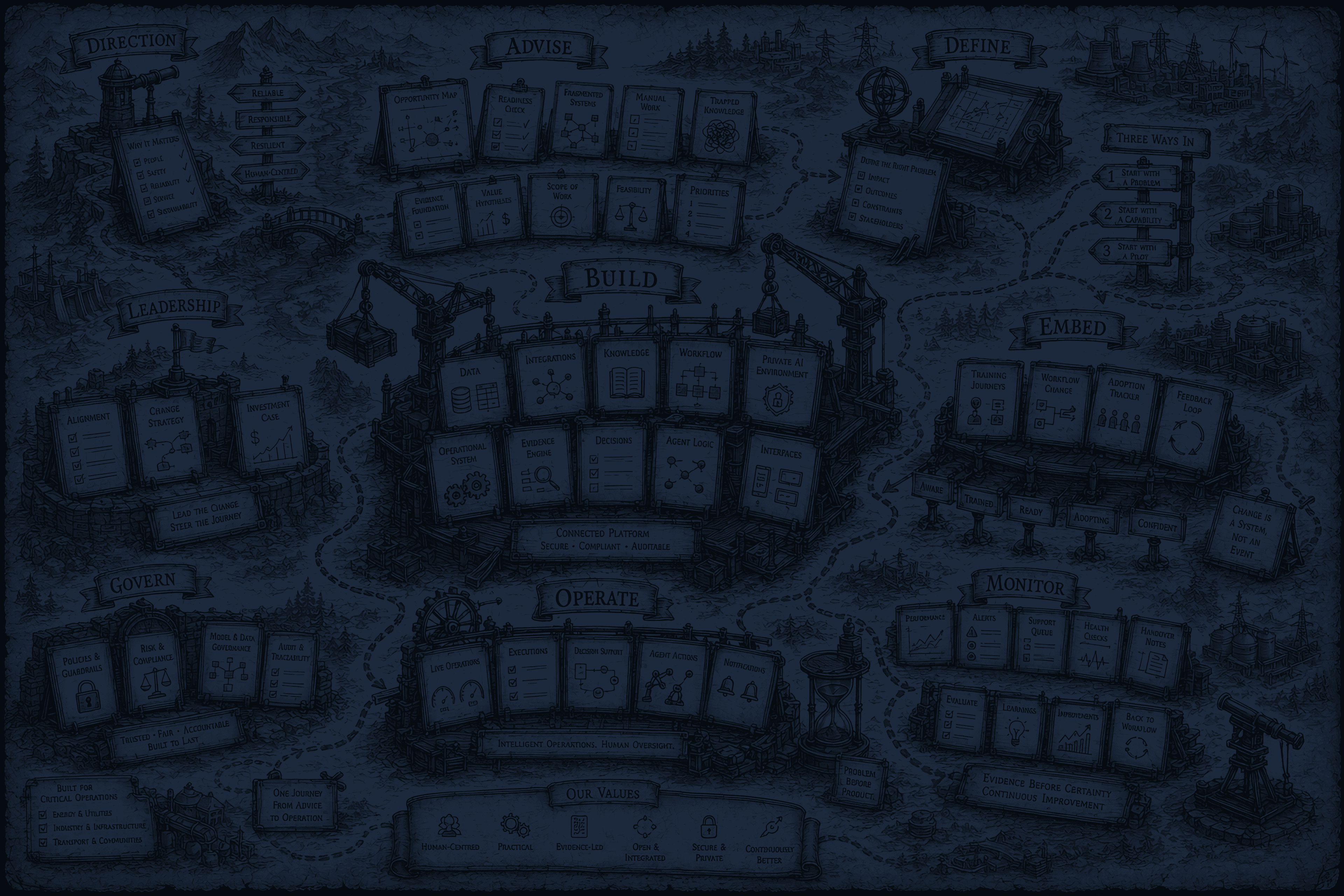
From problem to working system
Technology and product delivery
For organisations with a defined problem that now needs a working system. We shape the product, data and technical approach, then design, build and integrate a capability that fits the way your operation actually works, and keeps working.
What we design and build
You arrive here when diagnosis is done: the problem is defined, the value is understood, and what is missing is a dependable system. The systems we build for that moment cluster into a few recognisable kinds, though most real engagements combine them.
- Private AI environments
- AI capability deployed inside your governance boundary, on infrastructure you control, using the model architecture your data sensitivity and accuracy requirements actually justify. Built so its behaviour can be evaluated, its sources cited and its limits enforced, which is what makes AI usable in regulated operations.
- Intelligent operational systems
- Software that senses, decides and assists inside real workflows: condition monitoring, anomaly detection, scheduling and dispatch support, quality assurance. The intelligence is embedded in the operation's own tools and rhythms rather than parked in a separate dashboard nobody opens.
- Connected software and integrations
- Joining the systems you already run so data moves once, correctly. Integration work is unglamorous and decisive: most operational pain we meet is not a missing system but six existing ones that disagree.
- Decision, insight and knowledge tools
- Systems that put timely evidence and institutional knowledge in front of the people making decisions: retrieval over your documents and history with cited sources, structured analysis of operational data, and interfaces built for the decision, not the database.
- Workflow automation
- Removing slow, repetitive and unreliable manual steps while keeping people in control of what matters. We automate the work people should not be doing, and deliberately do not automate the judgement they should.
- Custom applications and products
- Purpose-built software, including customer-facing products, when nothing off the shelf fits the way you work. Built to production standards from the start, because a product is a promise to keep working.
Buy, integrate or build
The most expensive sentence in enterprise technology is "we build everything". The second most expensive is "we never build anything". The right answer is almost always a proportion: existing products where the problem is commodity, integration where the value is in connection, and custom engineering only where your operation genuinely differs from the average the market builds for.
We choose that proportion from your constraints: the sensitivity of the data, the systems already in place, the skills of the team who will inherit the result, and the cost of failure in your operating environment. The reasoning is written down and argued in front of you, so the architecture survives the people who chose it.
The right model for each job
The same proportion discipline applies inside the AI itself. Model choice is not a loyalty decision; it is three engineering decisions made per task, with the reasoning written down.
- Capability. Frontier models where the task genuinely justifies their cost and their terms; open-weight models deployed inside your boundary where a well-engineered smaller model does the job dependably. An estate designed this way usually ends up mixed, and should.
- Governance. Routing between models is an explicit, auditable design decision: which data may cross which boundary, for which task, under whose authority. Sensitive workloads stay inside your control; commodity workloads may use frontier services; and the seams between them are documented, not accidental.
- Unit economics. Token efficiency is an engineering discipline: right-sized models per task, caching, prompt and context budgets, and cost measured per outcome rather than per token, so the AI bill scales with the value delivered rather than with enthusiasm.
What we are really architecting is not a model choice but the system around the models: what context, data, integrations and permissions each function's AI can reach, how tasks are routed to the right level of intelligence, and where the guardrails sit. Models are components inside that system; the system is what you own and what compounds.
And because everything beneath that system keeps moving, we build it expecting to rebuild parts of it. Any AI system built today should assume significant revision within months as models, tooling and expectations shift, so swappable components, continuous evaluation and clean seams are designed in from the start rather than retrofitted as maintenance. Models are swapped when a better or cheaper one proves itself, and the evaluation that proves it is part of the build. Done this way, the churn beneath you stops being a threat and becomes a standing offer: every few months, something better arrives, and your system is built to say yes to it.
A build you can watch working
We build in close, visible iterations with the people who will run and use the system, and the reason is practical. The operator who will live with the system is the person best placed to spot the workflow-breaking detail while it is still cheap to fix, so working software goes in front of them from the earliest weeks. Users who help shape a system defend it later, which is half of adoption done early.
- Working software is shown from the first weeks, on real data as early as governance allows, because feedback on slides is fiction.
- Your team works inside the build if you want them to. Capability transfer starts during delivery, not at handover.
- Progress is reported against the operational outcome the system exists for.
- Scope changes are decisions made with you, their cost visible before they are made, so the schedule never breaks by surprise.
Engineering you can inspect
Operational systems earn trust through their engineering, and the engineering should withstand inspection by your own people or anyone you hire to check ours. As standard, that means security designed in from the architecture stage; automated testing and deployment so releases are boring; AI behaviour measured continuously against what the operation needs, with its failure modes documented, its fallbacks designed, and the evaluation records kept so the measurements can be re-run and challenged; and documentation written for the team who will own the system, not for the shelf.
Everything we build is yours: code, data, models, documentation and the knowledge to run them. We are comfortable being judged on what a follow-on team finds when they open the repository, and the standard is held personally by the founders, whose names are on every engagement.
After launch
A system creates value only when the organisation uses it and keeps using it. Delivery therefore connects directly into adoption and organisational change, where the workflow, training and trust are built alongside the software, and into managed AI and technology when you want the capability operated, evaluated and improved after go-live. Both are choices: you can equally take delivery and run everything yourselves, with our help ending at a clean, documented handover. Either way, what you get is the same: a capability your operation trusts, and the freedom to decide what happens next from strength.
Tell us about the system that needs to exist.
Describe the problem it must solve, the people it must serve and the systems it must live alongside. We will help you shape the product, data and technical approach before a line of code is committed.
Your message goes to the people who would do the work.