How we work
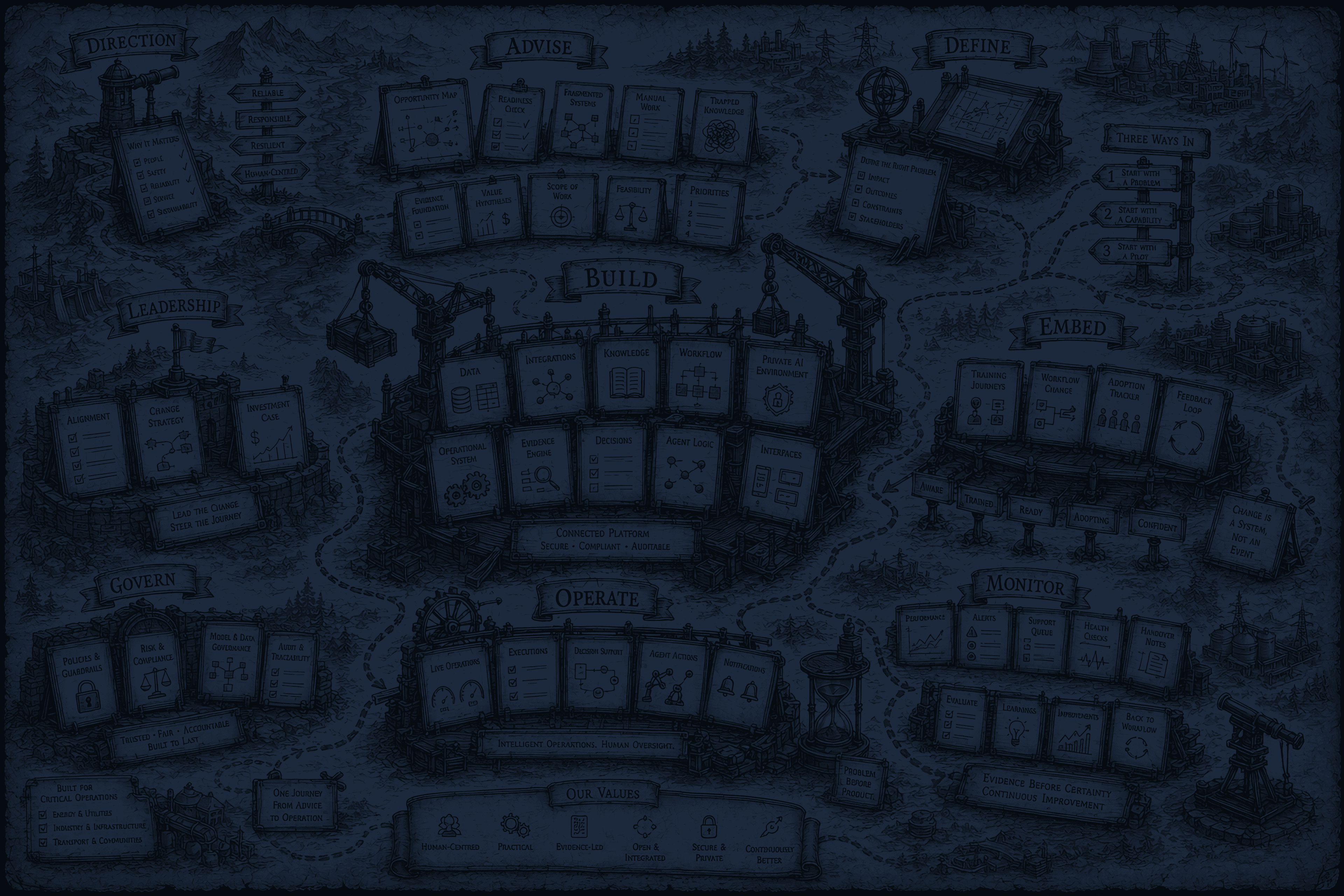
Advise, Define, Build, Embed and Operate: five stages that keep the commercial, technical and human parts of a change connected, with honest gates between them. Here is what actually happens at each stage, and what the discipline makes possible: momentum you can trust.
One journey, honestly gated
The classic technology failure is a handover failure. A strategy firm recommends, a development supplier builds from the recommendation's shadow, a change team inherits whatever arrives, and the operation lives with the result. At every join, context leaks and accountability dissolves.
Our answer is structural: one team carries the work from first question to running platform, and the stages are joined by gates, points where the evidence is weighed against criteria agreed before the work began, and the options on the table include stopping. A gate is a real decision point: the measures of success were written down in advance, every piece of evidence says where it came from, and the decision rests on the agreed criteria rather than on momentum. That discipline in its most concentrated form is the Evidence Sprint, and it runs through every stage of the journey.
Advise
What is really going on, and what is it worth changing?
We work to understand the organisation as it actually operates: time with the people who do the work, examination of the systems and data involved, and the commercial context that decides what any change is worth. Where the work turns on numbers, we measure the current state and agree the baseline with you, so the change has a starting point everyone accepts. Advise is where assumptions go to be tested, including ours.
What you see: findings as they form, not a reveal at the end; a shared, evidenced description of the problem and the value at stake.
How this protects you: you only spend on the next stage when there is a problem worth solving and its cost today has been measured.
Define
What exactly should change, and how will we judge success?
Definition turns a direction into something buildable: the workflow as it will be, the system boundary, the architecture chosen for your constraints, the data plan, and the measures that will decide whether the change worked. Definition is cheap; building the wrong thing is not.
What you see: the product, data and technical approach taking shape in front of you, with the trade-offs argued openly.
How this protects you: nothing gets built unless the evidence supports it, against success criteria and stop conditions you agreed in writing.
Build
Does the capability work, in our world, for our people?
We design, integrate and engineer in close, visible iterations with your teams and users inside the work. Security, evaluation and maintainability are built in as we go, because retrofitting trust is the most expensive way to acquire it.
What you see: working software within weeks, exercised on your real data as soon as governance allows, with progress reported against the operational outcome.
How this protects you: you judge the build in your operation, not in a demonstration.
Embed
Do people trust it enough to change how they work?
We help leaders set the conditions, involve the workforce in shaping the change, redesign the workflow around the new capability, and run training and feedback that persist beyond launch week. What operators say they would need before relying on the system is treated as a requirement, not a comment. What we learn here changes the system, not just the rollout plan.
What you see: adoption measured properly: persistent usage, retired workarounds, and the concerns raised and visibly acted on.
How this protects you: you will know adoption is real when the old way stops being missed, not when training attendance hits one hundred per cent.
Operate
Is it still earning its place a year later?
We support, monitor, evaluate and improve the capability as needs evolve, with your ownership designed in and handover available whenever your team is ready to carry it alone. The measures that justified the capability are refreshed as it runs, so the journey's last stage keeps answering to its first.
What you see: evidence, not reassurance: what was measured, what changed, what it means, and where the capability should go next.
How this protects you: the journey continues, or concludes, on evidence you can see, and either way the next decision is yours.
Entering mid-journey
The journey describes how the work connects, not a queue you must join at the back. Organisations enter wherever their situation puts them:
- At Advise, when the problem itself is still unclear.
- At Define or Build, when you already know what has to exist. We start by testing the definition we inherit, briefly and candidly, because building on someone else's untested assumptions helps nobody.
- At Embed or Operate, when a system exists but is not yet working for the organisation. This is a common and fixable situation, and arriving here is nothing to be embarrassed about.
Wherever you enter, the same team carries the context forward, so nothing important is lost between stages, and that team is led by founders you can meet before you commit to anything.
The team inside your team
Across every stage, the delivery unit is the same: a small embedded pod made up of our engineers and specialists, your domain experts, and the operators who will live with the result. The pod owns its piece of work end to end, from first observation through build into its early weeks of real operation, so accountability never changes hands mid-journey.
Pods begin by watching the real work before changing any of it. Process diagrams and procedure documents describe the official version of a workflow; the truth lives in the exceptions, workarounds and judgement calls, and a system built from the official version breaks on contact with the real one. Time spent observing is the cheapest insurance a build can buy.
Because your people are inside the pod rather than reporting to it, capability transfer happens by osmosis from the first week, not as a handover chapter at the end. Internal teams keep ownership and grow through the work. Incumbent systems and suppliers are respected until evidence says otherwise, because the operation's stability is worth more than our preferences.
Transforming while trading
No operating business can pause for six months to redesign itself around AI. Transformation happens while the operation keeps serving its existing customers through its existing products, and the journey is built for that reality: bounded stages, visible iterations, and changes that land inside the workflow rather than beside it.
Two disciplines make it workable. First, work is redesigned, not bolted onto: attaching AI to processes designed for a pre-AI world is how organisations end up paying for capability they cannot absorb, so each stage reshapes the workflow around what the technology actually changes. Second, you learn on yourself first: prove the new ways of working inside your own operation, where the stakes are controllable, and let what you prove internally shape what you later offer your customers. Some businesses are pulled the other way round by their market, and that is fine; the point is that the sequence is chosen deliberately, not by default.
What this is not
The journey is not a certified methodology, a rigid sequence or a lock-in. It is a discipline for keeping decisions, delivery and people connected, applied with judgement to your situation. Any stage can be the last if the evidence says so, and everything we produce along the way is yours to keep whether or not we continue together.
Tell us where you are.
Describe the problem, the programme or the system in front of you. We will help you work out which stage you are really at and what the next stage needs from you.
Your message goes to the people who would do the work.