Where programmes are won
Adoption and organisational change
A technically working system creates value only when the organisation can use, trust and sustain it. That makes adoption the place where AI programmes are actually won, and it is very winnable: we design the adoption alongside the technology, with the leaders, teams and users who have to live with the result.
Why adoption fails
Most failed technology programmes do not fail technically. The system passes its tests, the invoices are paid, and eighteen months later the operation is quietly running the old way with the new system as expensive decoration. The failure happened in the gap between a working system and a working organisation, and it usually has recognisable causes.
- Sponsorship evaporated. Leaders approved the purchase, announced the ambition, and were absent for the uncomfortable months when the change actually asked something of people.
- The workflow was an afterthought. The system was designed against requirements; the way work actually flows, with its exceptions and unofficial fixes, was discovered at rollout, in production, by the people living with it.
- The people who knew were never asked. The operators and specialists who could have said what would break were consulted late or not at all, and their first genuine involvement was being told to change.
- Training was an event, not a capability. One session at launch answered questions nobody had yet, and there was no route for the questions that arrived in week four.
- Concerns had nowhere to go. Doubts and workarounds stayed invisible until they hardened into a culture of quiet rejection that no relaunch could reverse.
Here is the encouraging part: every cause on that list is known, preventable by design, and squarely within your control. Designing them out with you, from the start, is exactly what we do.
Making the change stick
Adoption work is practical. It is not a communications plan bolted to a delivery, and it is not therapy. It is a set of design decisions about how the change meets your organisation, made deliberately and early.
- Leadership conditions
- Working with leaders on what the change needs from them: a direction people can repeat, visible use of the new way, honest acknowledgement of what is hard, and staying power through the middle of the change when enthusiasm has faded and habit has not yet formed.
- Workforce involvement
- Bringing operators and users into the design while it can still move: structured sessions in the real workflow, early access to working software, and genuine authority to change what does not fit. Involvement is the cheapest adoption instrument there is, and the most commonly skipped.
- The operator-adoption assessment
- A structured conversation with each key role before anyone commits to a deployment, built around one question: what would this system have to show you before you would rely on it? The answers are recorded in the operators' own words and become acceptance criteria for the build. The output is an adoption risk register with a design response for each risk, and a priced line for the involvement, training and feedback the deployment will actually need. Two rules are stated aloud at the start: we assess the change, never the people, and no individual is ever scored or reported on.
- Champions who carry practice outward
- The teams succeeding with AI, often engineering first, develop habits worth spreading: decomposing work, reviewing machine output critically, supervising rather than doing. We identify the early adopters, capture what actually works in their hands, and transfer those practices into sales, operations and back-office teams, translated for each function rather than imposed on it.
- Workflow, role and capability change
- Redesigning how work flows around the new system, and being candid about what shifts: which tasks disappear, which judgements move, which skills need building. Pretending roles will not change is how trust is lost before the system arrives.
- Training as infrastructure, not events
- When work shifts from using tools to supervising agents that perform tasks, training stops being an optional technique course and becomes operational infrastructure. We build enablement the way we build systems: staged around when people actually need it, grounded in their real workflow rather than generic videos, learned by doing the work with the AI rather than watching slides about it, and maintained past launch with named routes for help.
- Listening with consequences
- Channels that surface concerns, workarounds and ideas while the rollout can still respond, and a visible loop from what was heard to what changed. When people see their feedback land, they keep offering it, and the rollout keeps getting better.
- Psychology, applied carefully
- How people respond to change under pressure informs the work throughout: how the change is introduced, how competence is protected, how early failures are handled. We use this to design better change, not to promise wellbeing outcomes we cannot deliver.
Designed with the build
The reason adoption sits inside Ballista rather than beside it: the biggest adoption decisions are technical decisions. What the system automates versus assists, how it handles the operator's exceptions, how it explains itself, how it fails, whether it respects or erases the expertise of the person using it. Those choices are made during the build, which is where we make them, with delivery and adoption as one conversation. What we learn during rollout flows back the same way: the system changes because of what the organisation teaches us, not just the other way round.
Budgeting for the human half
Most AI budgets spend almost everything on the technology and almost nothing on the people expected to use it, and then record the predictable result as a mystery. We plan the other way round. Every proposal we make prices the human half explicitly: involvement time for the operators who will shape the system, training that persists past launch, and the listening work that keeps the rollout honest. That adoption cost line sits inside the value case itself, so the people the deployment depends on are funded from the start.
Two line items get particular care. Job redesign is budgeted as design work, because roles genuinely change and pretending otherwise just moves the cost into attrition and resentment. And the load on middle managers is planned, not discovered: automation below them sends the exceptions and judgement calls upward, and that new load has to be staffed and budgeted rather than absorbed by default.
Safety and the honest promise
Anxiety about AI is now a measurable feature of most workforces, and it is expensive: anxious people disengage, resist without saying so, and route around the systems they distrust. Making people feel safe in the change is therefore not pastoral decoration on a rollout. It is ROI protection, and it is designed with the same seriousness as the architecture.
Part of that design is honesty. Promising that nothing will change convinces nobody, and costs trust the rollout then has to buy back. What works is a promise leadership can actually keep, made early and kept visibly. What that promise contains, and how it is kept at every level of the organisation, is where empowering your people picks up.
How you will know it worked
We do not measure adoption by log-ins in launch week. The measures that mean something are slower and harder: usage that persists after the novelty and the mandate fade; workarounds that retire because the new way is genuinely easier; operators who correct and extend the system because they consider it theirs; and, eventually, the old way not being missed. Adoption is real when the change has become how work is done, not something done alongside work.
Where it leads
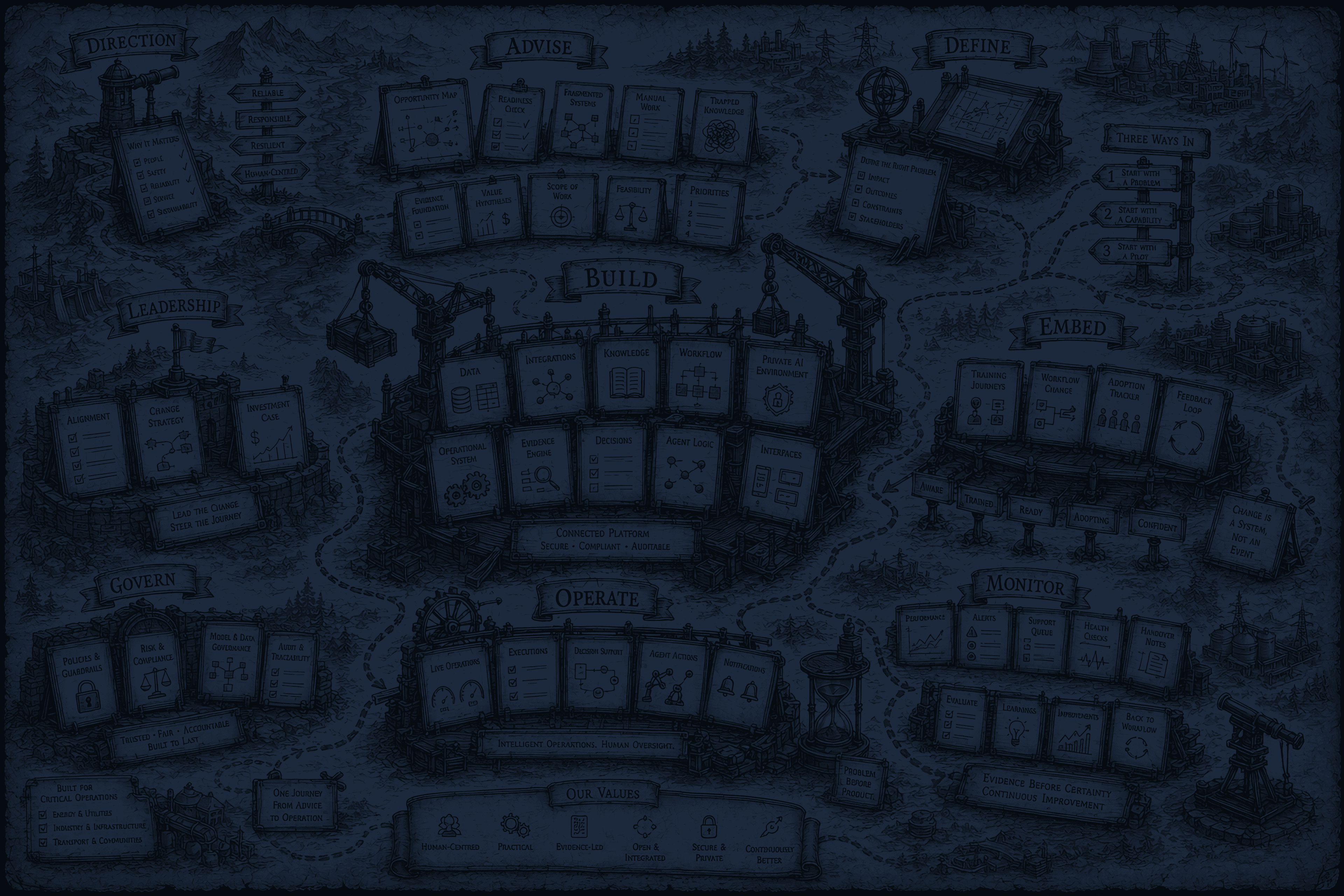
Adoption is the heart of the Embed stage of the Ballista journey, and it hands forward naturally: the listening channels, measures and improvement habits built during rollout become the raw material of managed operation. Where the organisation needs senior capability to carry a change of this kind, fractional leadership provides it for the season it is needed. Whichever route fits, the people designing it with you are the founders, the same faces from the first workshop to the last review.
Talk to us before the rejection sets in.
Tell us about the change you are planning, or the one that is stalling. We will help you understand where the risk sits, whose work is affected and what would make the change stick.
Your message goes to the people who would do the work.