Value after launch
Managed AI and technology
Launch is where the value starts compounding. We support, monitor, evaluate and improve running capability, under an operating model agreed around your systems and your team, so it keeps earning its place, and keeps getting better, until you choose to carry it alone.
Why systems need attention
The conditions a system was built for begin changing the day it goes live. The operation evolves, and yesterday's perfect workflow stops fitting. Platforms and dependencies shift underneath the code. Usage reveals needs no design phase could have predicted. Security expectations rise. The people who built the system move on, taking context with them. None of this is failure; it is what being in production means.
A capability that is merely hosted feels that drift eventually, usually at the least convenient moment. A capability that is watched, evaluated and improved keeps its promises through all of it, and gets a little better each quarter. Keeping those promises, and compounding them, is exactly the job we take on.
What we keep doing for you
The operating model is agreed around your capability, your risk profile and your team, not sold from a fixed service catalogue. For a workflow whose value has been measured, the simplest form is a measurement retainer: the metrics refreshed monthly or quarterly, offered alongside the Evidence Sprint. Beyond that, the work draws on a consistent set of disciplines.
- Support and monitoring
- Keeping the capability available and watched, with problems noticed by instrumentation before they are reported by your operation, and a named route to a human who knows your system when something needs judgement.
- Evaluation and quality
- Measuring how the system actually performs in use against what the operation needs from it, continuously rather than annually, with the results visible to you rather than summarised into comfort. Where the capability began with a measured business case, it is re-measured against the same operational definitions, so the value that was claimed stays accountable to the value being delivered. Cost is evaluated the same way: per outcome delivered, not per token consumed.
- Governance and change management
- Model, dependency and platform changes managed deliberately: assessed, tested and scheduled, so improvement never arrives as a surprise and neither does a vendor's deprecation notice.
- Security and resilience
- The system's security posture and failure behaviour treated as ongoing responsibilities: patching, access review, backup verification, and honest answers about what would happen if the worst day arrived.
- Improvement from evidence
- Operational data and user feedback feeding a deliberate roadmap agreed with you, so the capability is extended where the evidence says the value is, rather than where the most recent meeting pointed.
Why AI is different to run
Conventional software mostly fails loudly: an error, an outage, a ticket. AI-enabled systems can fail quietly: still answering, still confident, gradually less right as the data, the models or the world drift away from the assumptions they were built on. Quiet failure does not raise alerts; it erodes decisions.
Operating AI therefore means evaluating it continuously against ground truth the operation trusts, watching for drift rather than only downtime, keeping humans meaningfully in the loop where consequences warrant it, and being willing to switch models, architectures or approaches when the evidence says the current one is no longer the right choice. This is a discipline, and it is the heart of what "managed AI" means here.
There is a second kind of quiet change, and this one arrives from outside. Providers tune safety classifiers continuously, and a request that trips one is not always simply refused: it may be answered by a different and less capable model, or answered more narrowly than before, with the work carrying on either way. A provider reporting that a filter blocks a targeted behaviour in over 99% of cases is telling you about that behaviour, not about your workload, and the work most likely to trip a security filter is security work, because defenders and attackers describe the same techniques in the same words. So we instrument refusals and reroutes as an operational signal beside accuracy and cost: which workflows are being blocked, how often, what answered instead, and whether what reached the user is still what the system was evaluated to produce.
Keeping the estate governed
Governance is established once, and from that point it decays unless somebody maintains it. Models get swapped, systems are added, a workflow changes shape, the person who owned something leaves. Everything we operate stays under the discipline set out in AI governance and ownership: owned, scoped, evaluated and switchable. Operation is where those facts are kept true rather than merely established. The register is updated as the estate changes, evaluations are re-run when a model or a workflow moves underneath them, and anything that has stopped earning its place is retired instead of left running unowned. Where the estate includes agents, software that acts rather than only answers, this matters most: an agent drifting outside its remit does so while continuing to work.
Observability and cost governance
AI consumption does not behave like software licensing. Agentic systems consume intelligence the way an operation consumes labour: variable, workload-driven, and capable of surprising you. Per-seat budget instincts do not survive that shift, and the reflex response of hard usage caps protects the number while starving the work that was earning it.
Our answer is the same as for any operational cost: measure before you allocate. We instrument the estate so you can see what each workflow, team and agent actually consumes and what it produces, attribute cost to outcomes rather than to an aggregated monthly bill, and turn provisioning into a value decision: which work deserves the expensive model, which runs happily on the cheap one, and which should not be running at all.
The visibility itself is the durable asset: models and tooling will keep changing underneath it, and it carries over intact each time a component is swapped.
Ownership and exit
- You own everything. Code, data, models, infrastructure configuration, documentation and runbooks are yours from day one, held where you can reach them.
- Scope is written down. What we operate, what you operate and how the responsibilities meet are explicit, and revisited as the capability and your team mature.
- Reporting is evidence. You see what was measured, what changed and what it means, not a dashboard of reassuring green lights.
- Exit is a designed feature. Knowledge transfer runs continuously, and when you are ready to operate alone, the handover is a planned step on a date you choose.
- The accountability is personal. The people answerable for your system are the founders, and they stay reachable for as long as we operate it.
Where it leads
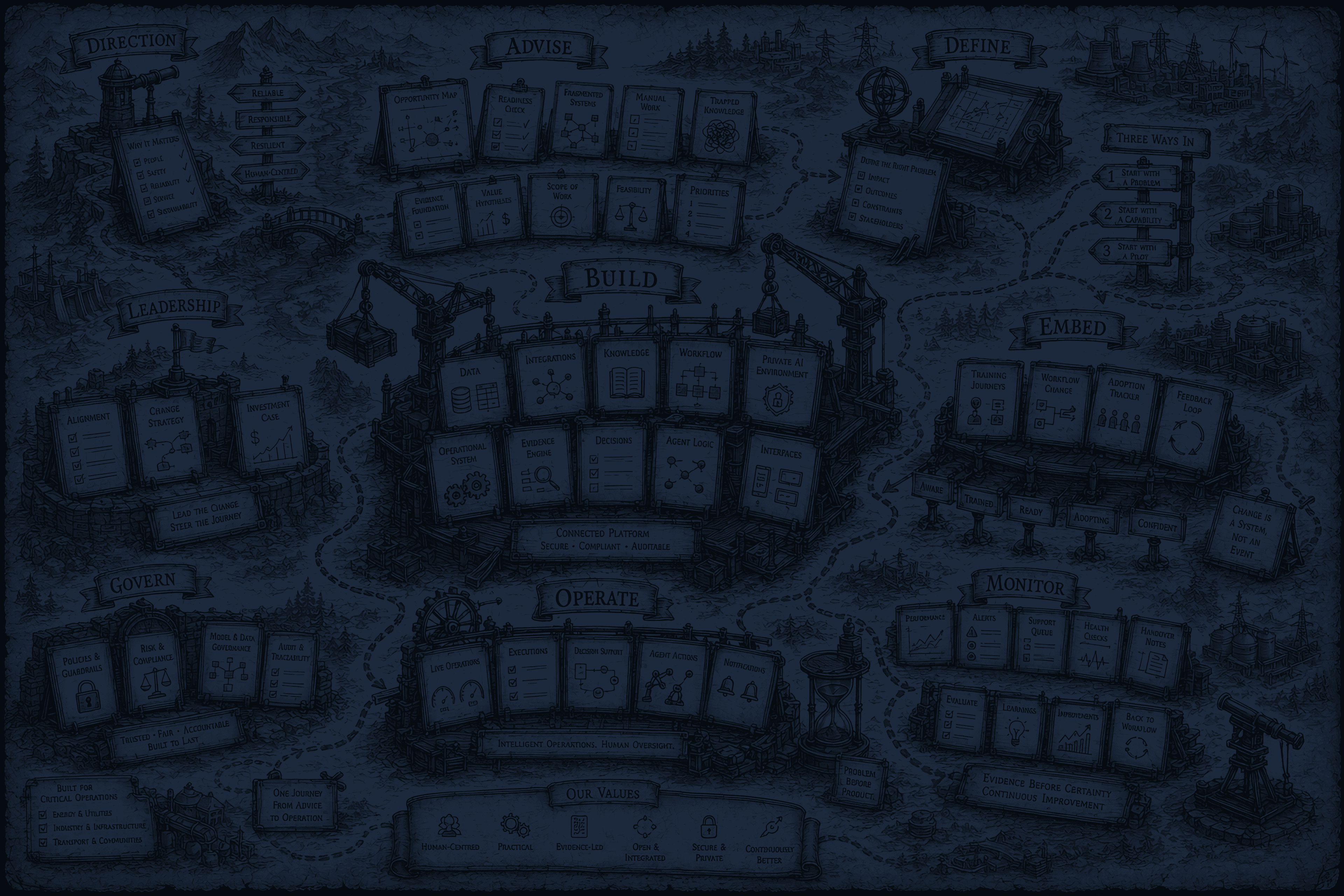
Operation is the Operate stage of the Ballista journey, and it feeds everything before it: what we learn running a capability becomes the evidence for the next round of direction and the requirements for the next build. That loop, run honestly, is how operational technology compounds instead of decaying.
Tell us what must keep working.
Describe the capability you are running or planning, who depends on it and what worries you about its future. We will help you work out what accountable operation should look like.
Your message goes to the people who would do the work.