About Ballista
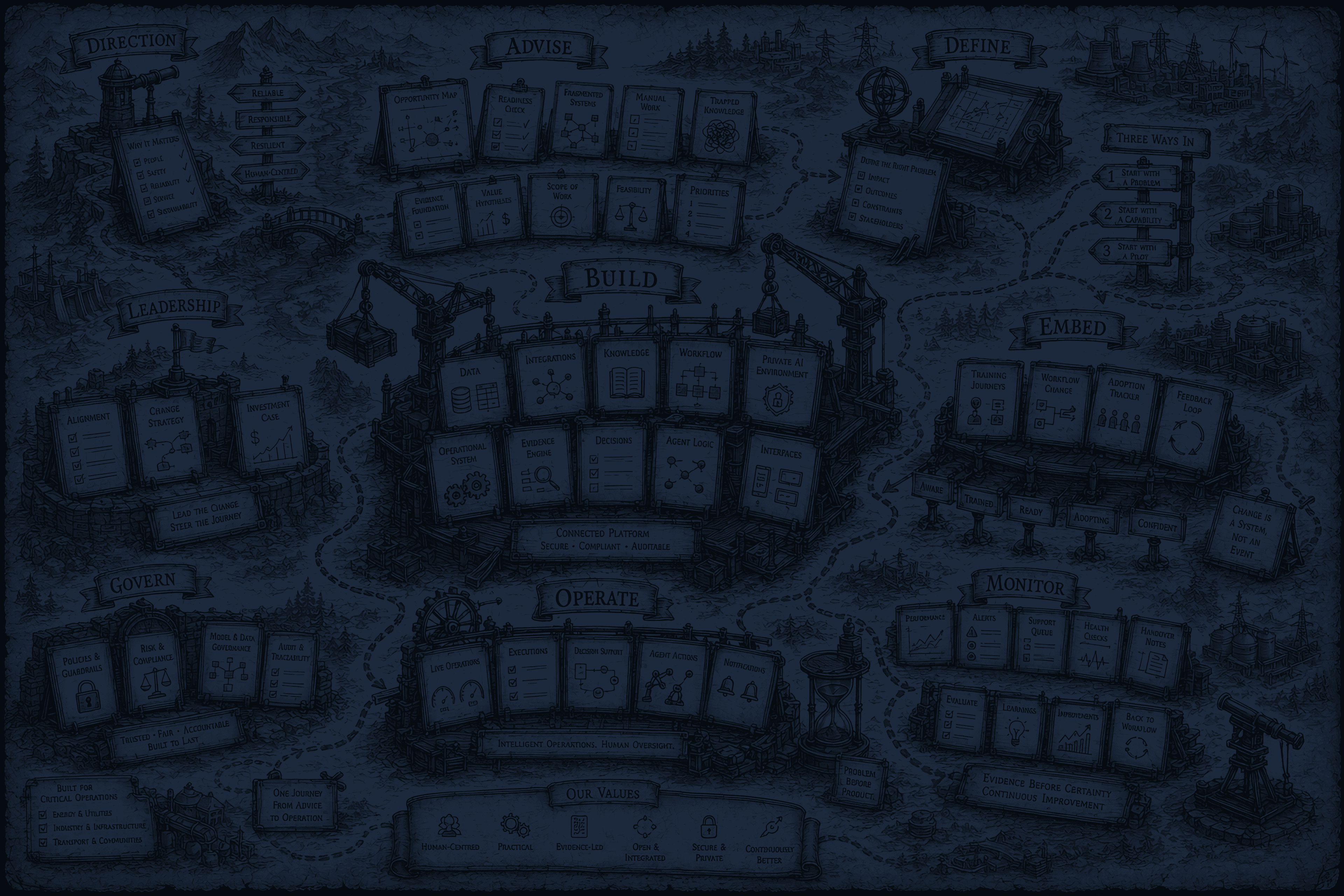
Ballista exists because of a gap that appears wherever complex organisations buy technology change: advisers who stop at the recommendation, builders who stop at the handover, and change programmes that never reach the people doing the work. We built the company that refuses to split the job.
Why Ballista exists
Organisations with complex operations buy technology change in fragments. Strategy from one firm, software from another, adoption from a third if it is bought at all, and operation from whoever is left holding the pager. Each supplier is accountable for a fragment; nobody is accountable for the outcome. The gaps between them are where context leaks, where costs hide, and where good intentions go to become shelfware.
Ballista was built as a refusal of that structure. One team carries the work from the first question to the running platform, and the same people who form the recommendation stay accountable for what it becomes in the operation. That is not a slogan about integration. It is the company's design.
One team, deliberately
Four disciplines that usually live in separate firms live here in one room: commercial judgement, so every recommendation answers to a business case; scientific and technical rigour, so claims about AI run behind the evidence; production engineering, so what we recommend can actually be built and run; and organisational change, because a system nobody adopts is furniture. The problems we serve do not divide themselves into those categories, so neither do we.
The principles
Four principles govern the work. They appear across this site because they appear across our decisions, and we are content to be judged by them.
- Problem before product
- We begin with the operational problem, the people affected and the outcome worth pursuing. Technology follows the evidence, and sometimes the evidence says the answer is not technology.
- Evidence before certainty
- Commercial value, technical feasibility, operational data and adoption risk are tested before confidence turns into commitment. This applies to our own recommendations most of all.
- People involved early
- The leaders, operators and users who live with a change help shape it while it can still move. Adoption is designed, not announced.
- Responsibility beyond launch
- We stay accountable for how technology behaves in use, and we build organisations that can eventually carry the capability without us. Dependence is a failure state, not a business model.
The people responsible
When you work with Ballista, these are the people answerable for the work.
- Piers CorfieldChief Executive Officer
- Piers has spent twelve years building and leading technology companies in and around energy: six investment-backed ventures, more than £15m raised in innovation finance, and at Dashboard Limited (now Klarian), a business that put hybrid AI to work on live operational data for infrastructure operators. He has been the founder, the operator and the board member, which is why conversations with Ballista start with the business problem and not the technology. As Chief Executive he leads the firm's direction and its customer relationships, and holds every engagement to one test: it has to matter operationally.
- Dr Lu XingAI Scientific Advisor
- Dr Lu Xing is an Associate Professor at Northumbria University and a Chartered Engineer whose research field is exactly Ballista's: AI in energy systems. Her record runs to more than seventy peer-reviewed papers, over 2,100 citations, and Principal or Co-Investigator roles on more than £14m of research with EPSRC and Innovate UK, with a PhD from Oklahoma State University and research experience alongside the US Department of Energy. Lu is the reason Ballista's claims about AI run behind the evidence rather than ahead of it: the science in every engagement answers to her.
- Anthony SmithChief Technology Officer
- Anthony has led technology and product for most of his career: finding the opportunity, understanding the market and the customer, and taking the product all the way from strategy to a platform running at national scale. He has built and run high-stakes commercial systems handling real-time data, and he stays deliberately hands-on, from architecture to code, because the technology leaders worth trusting are the ones who can still build. As Chief Technology Officer he leads Ballista's product and engineering practice and owns the standard the work is built to: dependable, secure, and ready to hand over.
The wider team
Around the founders, the wider team deepens what every engagement draws on: commercial evidence, governance thinking, the psychology of adoption, and clear communication.
- Dana CorfieldPeople & Wellbeing
- Dana leads the human side of Ballista's engagements: helping the people inside a client organisation adopt the change, and caring for them while they go through it. She is a BACP-registered therapist and qualified clinical supervisor with thousands of client hours behind her, much of them spent with professionals navigating workplace stress, change and self-doubt. Technology change asks a great deal of the people who live through it. Dana's job is to make sure the involvement, support and pastoral care around every change respects the person as well as the process.
- Chris SmithPartnership & Sales Director
- Chris brings fifteen years of senior commercial leadership to Ballista's partnerships and client relationships. He has built and led large sales teams, advised CFOs, founders and boards, and worked with everyone from start-ups to FTSE 100 organisations. His discipline is the commercial relationship itself: understanding what a business is actually trying to achieve, what its problems genuinely cost, and being straight about whether and how we can help. At Ballista he leads how new relationships and partnerships begin, and holds them to the same standard as the work itself: honest, evidenced and worth the client's time.
- Jay PatelCommercial Research Analyst
- Jay brings economic and commercial analysis to Ballista's client work, trained at the sharp end of it: FTI Consulting, Frontier Economics, Schroders and InvestIn. His discipline is the commercial evidence underneath every recommendation: the market a client operates in, the cost base technology has to move, and the numbers that decide whether an initiative deserves to exist.
- Aditya SharmaStrategy & Investor Research
- Aditya brings government-grade strategy and policy experience to how organisations adopt AI responsibly. At Grant Thornton Bharat he advised on India's National Clean Air Programme, one of the world's largest environmental policy programmes, and he has served as a Policy Fellow at India's Ministry of Commerce. At Ballista that thinking shapes how AI claims are assessed, what the evidence should show, and how findings earn the confidence of boards and investors.
- Angelina AlfonsoMarketing & Research
- Angelina brings research rigour and experimental psychology to the human half of Ballista's work. Technology succeeds when people adopt it, and her discipline is exactly that: how people actually respond to change, and how the involvement, support and education we design for client teams should reflect it. Her research experience spans MMGY Global and B2B growth consultancy for Eequ.
- Aditya SaravananDigital Marketing Strategist
- Aditya makes complex AI subjects clear enough to act on. He shapes how Ballista communicates, from published research to the guidance and educational material that travels with every engagement, so the thinking reaches the leaders and teams who need it in a form they can use. He has run B2B campaigns for AI companies, published at a national newspaper's pace, and is Google certified in digital marketing.
Working with us
Everything starts with a real problem, described plainly. From there, what we do explains the three ways in, and how we work explains the journey and its gates. Bring us something real and the first conversation will give you an honest view of whether and how we can help, whatever you decide to do with it.
Work with people who stay accountable.
The best way to understand Ballista is to bring us something real. Tell us about the problem, the decision or the change in front of you.
Your message goes to the people who would do the work.